Canon R50 vs R100: Which Is Better? (November 2026)
For Canon R50 vs R100, choose the R50 for moving subjects, self-recording and frequent video. Choose the R100 for posed photos, travel scenes and learning photography with a starter zoom.
On this page (11 sections)
- Canon R50 vs R100: which is better for beginners?
- How do the R50 and R100 compare for autofocus?
- Which camera is faster for action photos?
- Which is better for video, the Canon R50 or R100?
- Will either camera give better everyday image quality?
- Which kit works better in dim rooms?
- Is the included lens enough to start with?
- How should you set up either camera for your first outing?
- Which camera should you choose for travel and family photos?
- What care habits prevent common beginner problems?
- Canon R50 vs R100: which should you buy?
For Canon R50 vs R100, choose the R50 for moving subjects and frequent video, or the R100 for posed photos and still scenes. The most useful differences involve following movement, seeing your framing and recording yourself.
Both kits include a starter zoom, so you can begin learning without buying another lens. Pick the body around the moments you want to capture, then build your lens choices around what the starter zoom cannot do.
If you’re new to the camera type, our guide to what a mirrorless camera is explains interchangeable lenses and electronic viewing.

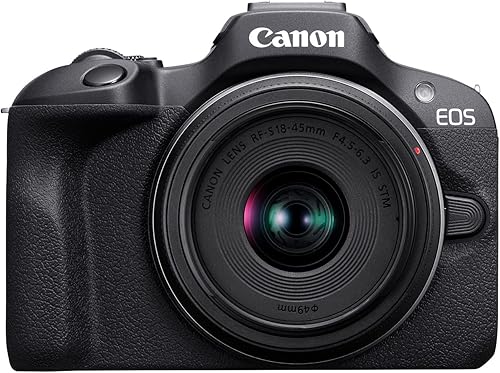
Canon R50 vs R100: which is better for beginners?
The R50 suits a beginner mixing photos and video, while the R100 suits someone concentrating on still photography. Starting with the R100 also means accepting its fixed screen, which affects how comfortably you can compose from different positions.
Learning photography means making choices about light, focus and framing on either body. Extra features help when they solve a real shooting problem, such as following a moving child or seeing yourself while recording.
Start by naming your 3 most common subjects. A list of children playing, pets and short videos points toward the R50; scenery, posed relatives and everyday objects makes the R100 easier to justify.
For alternatives, see our guide to the best beginner cameras for family photos and travel. The beginner’s guide to using the Canon R50 explains setup if that model fits your plans.
Canon R50 vs R100: who should skip each one?
Skip the R50 if its extra tools would rarely leave the menu. Someone making deliberate photos of buildings, food and still subjects has less need for its action features.
Skip the R100 if self-recording or awkward camera angles will be part of every outing. A fixed display is a daily constraint when the camera faces you, sits close to the ground or rises above your head.
Neither kit is an automatic solution for distant wildlife or indoor sports. Those subjects can demand more lens reach or more light than a starter zoom provides.
How do the R50 and R100 compare for autofocus?
The R50 is the stronger choice for following movement, with Dual Pixel CMOS AF II and subject tracking for people, animals and vehicles. Its autofocus covers up to the full frame width and height, with 651 zones.
The R100 uses Dual Pixel CMOS AF with up to 143 zones, human face and eye detection, and animal and vehicle detection. Detection alone therefore does not separate these cameras; the R50’s tracking tools matter more for an action-focused buyer.
For posed portraits, first confirm that the camera has selected the intended person. A face in the background can distract an automatic system, especially in a group or busy setting.
With pets, keep the face visible and avoid clutter between the camera and subject. Autofocus has an easier job when you give it a clear subject rather than asking it to pick through furniture, branches or other animals.
More focus zones do not replace that care. Look at the important area of a photo afterward, especially the eyes, instead of judging sharpness from the whole image at a small size.
Which camera is faster for action photos?
The R50 offers more frames during a brief moment, reaching up to 12 fps with electronic first curtain shutter or 15 fps with electronic shutter. The R100 reaches up to 6.5 shots per second in One-Shot AF.
The R100 figure is not a continuous subject-tracking rate. That distinction matters when comparing cameras for a child running toward you rather than someone holding a pose.
Use short bursts near the moment you expect the action to peak. Starting early and holding the shutter for too long creates more files to sort without improving your timing.
A fast burst also cannot cure motion blur. If a moving hand or face looks smeared, use a faster shutter speed and provide more light when possible.
Electronic shutters can distort fast movement or show bands under some artificial lights. If you notice either problem, try another shutter option rather than choosing the highest burst setting for every scene.
Which is better for video, the Canon R50 or R100?
The R50 offers more useful video flexibility, including 6K-oversampled, uncropped 4K up to 30 fps and Full HD up to 120 fps. The R100 offers central-area 4K up to 24 fps, Full HD up to 60 fps and HD up to 120 fps.
Central-area recording narrows the view. In a small room, you may not have enough space to move the R100 farther away while keeping yourself and the surroundings in frame.
The R50’s uncropped 4K gives you more room to work with at the same lens setting. This matters for self-recording, room scenes and showing an activity on a table.
High frame rates also involve choices about resolution and playback. Choose them for footage you plan to slow down, rather than assuming the largest frame-rate number is best for every clip.
Does the R50 make self-recording easier?
The R50’s vari-angle touchscreen makes self-framing easier because you can position the screen toward yourself. It also helps when you place the camera below eye level or above a crowd.
The R100’s fixed LCD works best when you can stand behind the camera. For a solo recording, plan the composition first and make a short practice clip to confirm where you can move.
For showing small objects, the R50 includes Movie for Close-up Demo Mode, which shifts focus to the subject closest to the camera. Leave a pause after bringing an object forward so the focus change can finish before you continue.
Keep clips simple while learning: set the camera in a stable position, choose your framing and record a short sequence. Review focus and movement before recording a longer piece.
Will either camera give better everyday image quality?
Sensor resolution should not decide this purchase: the R50 has a 24.2 MP APS-C sensor, while the R100 has a 24.1 MP APS-C sensor. That tiny count difference is not a useful reason to favor one kit.
The R50 pairs its sensor with DIGIC X processing, while the R100 uses DIGIC 8. Those names alone do not tell you which camera will make a better photo of your family in a particular room.
Light, shutter speed, focus and camera position will shape that result. A well-lit, sharply focused picture from the R100 can be more useful than a poorly timed or blurred one from the R50.
For an everyday portrait, move the subject away from a busy background and look for soft light. Small changes in where you stand often improve a picture more than changing camera settings at random.
Which kit works better in dim rooms?
Neither kit removes the need to manage light and movement indoors. Both include the same RF-S 18-45mm F4.5-6.3 IS STM lens, whose maximum aperture becomes smaller toward the longer end of the zoom.
Canon describes the R50’s Advanced A+ Assist as helping with night and backlit scenes. That is useful automatic support, but it does not guarantee a measured low-light advantage over the R100.
For a still subject, holding the camera steady can help when a slower shutter speed is needed. For moving people, prioritize a shutter speed that freezes movement, even if that means accepting a higher ISO.
Move closer to a window or add room light before assuming you need a different body. Avoid placing a person directly in front of a bright window unless you know how you want to handle the bright background.
Optical image stabilization in the kit lens helps with camera shake. It cannot freeze a child turning their head or a pet running through the room.
Is the included lens enough to start with?
The shared kit zoom is enough to learn your usual framing needs. Use its wider end for groups and surroundings, then zoom toward the longer end for tighter pictures of people or everyday details.
It is a short everyday zoom, so do not expect close views of distant birds or action across a large field. Moving closer is useful only when it is safe and allowed.
For portraits, avoid pushing the camera very close to a face at the widest setting. Step back and adjust the zoom for a more comfortable perspective.
Our explainer on what a kit lens can do covers the basics. Read whether a kit lens is good enough before replacing it simply because it came in the box.
Spend several outings noticing what you cannot frame. If the same limit keeps appearing, use our guide to the best lenses for the Canon R50 to connect a future lens choice to a specific need.
How should you set up either camera for your first outing?
Begin with a simple photo setup and a short practice session at home. Charge the battery, fit the lens securely and attach the strap before taking the camera somewhere busy.
Use a compatible memory card and format it in the camera after saving any files you need. If you choose the R50, our guide to the SD card the Canon R50 needs explains that part of the setup.
Start with automatic exposure while learning framing and focus. Photograph a still object, a person and a moving subject so you can see which situations need more attention.
Choose single-frame shooting for still scenes and short bursts for movement. For people, confirm that face or eye detection has selected your intended subject before pressing the shutter fully.
Review a few images at a larger view rather than filling the card without checking. If the background is sharp but the face is soft, focus needs attention; if the whole scene looks shaken, examine shutter speed and how you hold the camera.
Which camera should you choose for travel and family photos?
Choose the R50 for an unpredictable mix of movement and video, or the R100 for planned still photos. A travel day of scenery and posed pictures asks less of the body than following children through an activity.
The R100’s compact, lightweight body suits carrying between photo stops. The R50 makes more sense when you frequently change shooting height or switch from family photos to recording yourself.
Carry the camera where you can reach it, with the lens protected from loose objects. Our guide to traveling with a camera covers packing and access during a trip.
What care habits prevent common beginner problems?
Protect the lens, manage your files and keep dust away from the open camera. These habits matter with either kit and take less effort than recovering lost photos or removing marks later.
Use a blower to remove loose grit before gently wiping the front glass with a clean lens cloth. Rubbing grit with a shirt or tissue can damage the surface.
Change lenses in a sheltered place and keep the opening exposed for as little time as possible. Avoid touching the sensor or attempting casual cleaning inside the body.
Do not leave the camera loose in a bag with keys, drinks or food. Use a padded compartment and keep caps handy when the camera is packed away.
Back up photos before clearing the card, and confirm that the copied files open. Keep a second copy of important family pictures rather than treating the card as permanent storage.
Canon R50 vs R100: which should you buy?
Buy the R50 if movement, self-recording or frequent video defines your camera use. Its extra tools address those situations directly, so they are worth choosing when those needs are already part of your plans.
Buy the R100 if your routine centers on posed people, scenery and learning photo basics from behind the camera. Accept its screen and video limits before committing, rather than hoping accessories will make them disappear.
If you already have an R100 and your pictures disappoint you, identify the cause before switching bodies. A framing limit may call for a lens, while motion blur calls for a change in shutter speed or light.
For the final Canon R50 vs R100 decision, picture your next outing and the hardest moment you expect to capture. If that points you toward the R50, start with how to use the Canon R50 and practice before buying more gear.
Frequently asked questions
Is the Canon R50 better than the R100?
The R50 is the better choice for moving subjects and regular video because it combines subject tracking, faster bursts and a movable touchscreen; the R100 suits buyers who mainly photograph posed people and still scenes. Choose around those uses rather than the tiny difference in sensor resolution.
What is the main difference between the Canon R50 and R100?
The main difference is shooting flexibility: the R50 offers more options for following movement, framing from awkward angles and recording video; the R100 has a fixed screen and records 4K from the central sensor area. Those differences matter more in daily use than their nearly equal megapixel counts.
Are the Canon R50 and R100 good for beginners?
Both can suit beginners because each kit includes a body and an everyday zoom, letting you practice without choosing another lens first; the R50 fits beginners who want photos and frequent video. The R100 fits a still-photo learner who is comfortable composing with a fixed screen.
Can the Canon R100 record 4K video?
The R100 records 4K at up to 24 fps from the central area of its sensor, which narrows your view; it also offers Full HD at up to 60 fps and HD at up to 120 fps. Choose the mode around framing, motion and your intended playback.
Which Canon kit lens comes with these cameras?
Both kits include the RF-S 18-45mm F4.5-6.3 IS STM lens, a compact zoom with optical image stabilization; it covers wider scenes and tighter everyday views, but its maximum aperture gets smaller as you zoom in. Our guide to what a kit lens is explains those tradeoffs.


