Canon Rebel T7 vs Nikon D7500: Which to Buy? (November 2026)
The Canon Rebel T7 wins for most first-time buyers because its bundle covers wide, portrait and telephoto shooting in one box at the lower price tier. Pick the Nikon D7500 instead when fast autofocus, 8 fps bursts and 4K video matter more than included extras.
On this page (10 sections)
- Canon Rebel T7 vs Nikon D7500 side by side
- Which sensor and image quality should you pick?
- Which autofocus system handles moving subjects better?
- How much does shooting speed matter?
- Which camera is better for video?
- Which viewfinder, screen and handling suits you?
- What's in the box and what will you still need to buy?
- Who should buy the Canon Rebel T7?
- Who should buy the Nikon D7500?
- Canon Rebel T7 vs Nikon D7500: which should you buy?
The Canon Rebel T7 is the better camera for most first-time buyers. It arrives as a complete kit with two lenses, a spare battery, memory cards and a bag, so the Canon Rebel T7 vs Nikon D7500 choice often comes down to whether you want a ready-made starter setup or a faster camera body.
The Rebel T7 scores 9.7 and the Nikon D7500 scores 9.3. The D7500 is the stronger camera in several technical areas.
The right pick depends on what you plan to photograph in your first year.
Both are DSLR cameras with APS-C sensors. The Canon kit covers more shooting situations out of the box.
The Nikon brings a better autofocus system, faster bursts and 4K video.
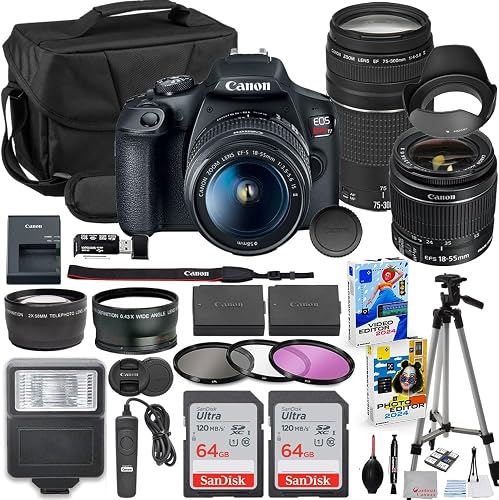

Canon Rebel T7 vs Nikon D7500 side by side
The Nikon D7500 is the faster, more advanced body; the Canon Rebel T7 is the more complete starter kit. The table below shows the differences that matter most when you're deciding between them.
| Feature | Canon Rebel T7 | Nikon D7500 |
|---|---|---|
| Sensor | 24.1MP APS-C CMOS | 20.9MP APS-C |
| Autofocus points | 9-point, center cross-type | 51-point, 15 cross-type |
| Continuous shooting | Up to 3 fps | Up to 8 fps |
| Video | Full HD 1080/30p | 4K Ultra HD and 1080p Full HD |
| Screen | 3.0 in 920k-dot LCD, fixed | 3.2 in 922k-dot LCD, tilting, touch |
| Connectivity | Wi-Fi with NFC | Wi-Fi and Bluetooth |
| Lens in the kit | 18-55mm and 75-300mm | 18-140mm |
The Canon's 24.1MP sensor edges the Nikon's 20.9MP on pixel count. That difference rarely decides a purchase, since both resolve plenty of detail for prints and sharing.
What stands out is the autofocus and speed gap. The Nikon's 51-point system and 8 fps rate make it far more capable with movement.
The Canon's 9 points and 3 fps are basic by comparison.
Which sensor and image quality should you pick?
Both sensors produce high-resolution stills; the Nikon's sensor and processor are built for tougher light. The Rebel T7 pairs a 24.1MP APS-C CMOS sensor with a DIGIC 4+ processor and a native ISO range of 100-6400.
That ISO range covers daylight and well-lit indoor scenes without much trouble. The Canon's Scene Intelligent Auto mode handles exposure choices for you when you'd rather not think about settings.
Nikon describes its sensor and processor as matching the award-winning D500 in image quality, ISO range and metering. That's a maker claim, but it points to stronger low-light and dynamic-range performance than an entry-level body.
Neither camera's sensor is full frame. Both use APS-C crop sensors, which means lenses carry a focal length multiplier.
On the Nikon, an 18-140mm lens gives roughly the same view as a 27-210mm lens on a full-frame camera.
For daylight landscapes, portraits and travel photos, the Canon's sensor is more than enough. For indoor events and evening shots where you push ISO higher, the Nikon's sensor has the edge.
Which autofocus system handles moving subjects better?
The Nikon D7500 wins this section clearly with 51 autofocus points and 15 cross-type sensors. The Canon Rebel T7 uses a 9-point system with a single center cross-type point.
More points mean the camera can lock focus across a wider area of the frame. Cross-type sensors are more sensitive to detail in both directions, which helps in low contrast and dim light.
The Nikon also offers group area autofocus. That mode uses a cluster of points to track a subject, which is useful for birds, pets and players on a field.
The Canon's 9 points and center cross-type design work fine for still subjects. Focus and recompose with the center point and you can shoot portraits and landscapes all day.
The limit appears when your subject moves across the frame.
If you photograph kids running, dogs in the park or any sport, the Nikon's autofocus is the difference between a sharp keeper and a missed moment. If your subjects sit still or pose, the Canon's system does the job.
How much does shooting speed matter?
The Nikon D7500's 8 fps burst is more than double the Canon Rebel T7's 3 fps, which matters for any moving subject. Frames per second decides how many moments you capture in a short window.
At 3 fps, the Canon takes three shots in a second. That's enough for a walking portrait or a slow-moving scene, but a sprinter or a diving bird moves far between frames.
At 8 fps, the Nikon captures nearly three times as many frames in the same second. You have more chances to land the peak action, whether that's a jump shot or a pet catching a ball.
The Nikon's continuous shooting pairs with its 51-point autofocus, so it can keep tracking as it fires. The Canon's 3 fps burst works better for static scenes and deliberate shooting.
Think about your usual subjects before you weigh this. A landscape photographer rarely needs 8 fps.
A parent photographing weekend soccer will notice the difference immediately.
Which camera is better for video?
The Nikon D7500 records 4K Ultra HD, while the Canon Rebel T7 stops at Full HD 1080/30p. That's the biggest single gap between the two cameras for anyone who wants to shoot video.
The Nikon adds 4K UHD time-lapse, stereo sound, power aperture control and auto ISO. Its tilting touchscreen helps when you frame from odd angles or shoot vlog-style clips.
The Canon records clean 1080p at 30 fps. Its fixed 3.0-inch LCD means you can't flip the screen forward for self-recording, and there's no 4K option.
For casual clips of family events or travel memories, the Canon's 1080p is fine. For YouTube content, wildlife video or anything you plan to watch on a 4K screen, the Nikon is the more useful camera.
If video is your main goal, mirrorless bodies are also worth a look. Our Canon EOS R50 review covers a camera built with vlogging and 4K in mind.
Which viewfinder, screen and handling suits you?
The Nikon's larger tilting touchscreen gives more framing flexibility; the Canon's simpler layout suits learners. Screen size and articulation change how you shoot in awkward positions.
The Canon uses a 3.0-inch 920k-dot LCD that stays fixed. It's bright enough for reviewing shots and fine for shooting at eye level through the optical viewfinder.
The Nikon's 3.2-inch 922k-dot screen tilts and responds to touch. Tilt it up for low-angle shots or down for overhead framing without crouching or guessing.
Both cameras have optical viewfinders, which show the real scene through the lens. That's a DSLR advantage over mirrorless cameras in bright light and for tracking movement.
The Nikon's touchscreen makes menu changes and focus point selection faster. The Canon's button-and-dial layout is simpler for a beginner learning the basics.
Try both in a store if you can. Grip size and button placement are personal, and the camera you enjoy holding is the one you'll actually carry.
What's in the box and what will you still need to buy?
The Canon Rebel T7 bundle is the more complete package, with two lenses and accessories the Nikon kit doesn't include. That matters when you're starting from nothing.
The Canon bundle includes the T7 body, an 18-55mm f/3.5-5.6 IS II lens and a 75-300mm f/4-5.6 III telephoto lens. You also get a spare Canon LP-E10 battery, two 64GB memory cards, a padded bag, a slave flash, a wired remote, a filter kit and lens caps.
The Nikon comes with the D7500 body and a single AF-S DX NIKKOR 18-140mm f/3.5-5.6G ED VR lens. That's a versatile zoom covering wide to medium telephoto, but you'll need to add memory cards and a bag separately.
The Canon's two-lens setup gives you more reach out of the box. The 75-300mm lens extends to 300mm, which is handy for distant subjects and tighter portraits.
The Nikon's 18-140mm stops at 140mm but covers the middle range in one lens you can leave on.
If you want to travel light with one lens, the Nikon's 18-140mm is the simpler kit. If you want to experiment with telephoto shooting without buying more glass, the Canon bundle covers it.
Who should buy the Canon Rebel T7?
Buy the Canon Rebel T7 if you're new to DSLRs and want a complete kit that covers wide, portrait and telephoto shooting on day one. Its 24.1MP sensor and easy auto modes keep the learning curve gentle.
The two-lens bundle means you can shoot landscapes at 18mm and reach for the 75-300mm when you want to zoom in. That flexibility in one purchase is hard to beat for a first camera.
Built-in Wi-Fi with NFC lets you pair the camera to a phone and share photos straight to social media. The Camera Connect app also enables remote control from your phone.
Choose the Canon if your main subjects are still or slow-moving: portraits, travel scenes, landscapes and family photos. The 9-point autofocus and 3 fps burst handle those well.
Skip it if you plan to shoot sports, wildlife or 4K video. The Nikon's speed and video specs are a better fit for those goals.
Readers who want a smaller modern alternative can read our Canon EOS R100 review.
Who should buy the Nikon D7500?
Buy the Nikon D7500 if fast autofocus, 8 fps bursts and 4K video matter more to you than a two-lens kit. Its 51-point autofocus system with 15 cross-type sensors is the strongest feature in this comparison.
The 8 fps continuous shooting and group area autofocus make it the pick for sports, wildlife and active family photography. You get more sharp frames from every burst.
The 4K Ultra HD video, stereo sound and tilting touchscreen suit content creators who want better footage than 1080p. The touchscreen also speeds up focus point selection.
The single 18-140mm lens covers wide to medium telephoto and stays on the camera for most situations. It won't reach as far as the Canon's 75-300mm.
Skip the Nikon if you want everything included in one box. The Canon bundle removes the need to buy cards, a bag and a second lens.
Shoppers comparing entry-level options can also read our Canon Rebel T7 vs Nikon D3500 breakdown.
Canon Rebel T7 vs Nikon D7500: which should you buy?
Pick the Canon Rebel T7 for your first DSLR if you want a complete, easy-to-use kit at a lower price tier. Pick the Nikon D7500 if autofocus speed, burst rate and 4K video are your priorities.
The Rebel T7 scores 9.7 and wins this comparison for most readers. Its 24.1MP sensor, two included lenses and full accessory kit make it the simpler way to start shooting without extra purchases.
The D7500 scores 9.3 and wins for action and video. Its 51-point autofocus, 8 fps shooting and 4K recording are real advantages, and they justify the higher price tier for the right buyer.
Decide by your main subject. Still portraits and travel scenes point to the Canon.
Moving subjects and 4K footage point to the Nikon. If you're still weighing smaller options, our Canon R50 vs R100 comparison covers two mirrorless alternatives.
Frequently asked questions
Which camera is better for video, the Rebel T7 or D7500?
The Nikon D7500 is the better video camera here because it records 4K Ultra HD and 1080p Full HD with stereo sound. The Canon Rebel T7 tops out at Full HD 1080/30p, so choose it only if 1080p clips are enough for your needs.
Can the Canon Rebel T7 shoot fast action?
It can, but it is not built for it. The Rebel T7 shoots at up to 3 fps with a 9-point autofocus system, while the Nikon D7500 reaches 8 fps with 51 autofocus points.
For sports, wildlife or active kids, the D7500 is the safer pick.
Does the Nikon D7500 come with two lenses like the Rebel T7 bundle?
No. The Nikon D7500 comes with a single AF-S DX NIKKOR 18-140mm f/3.5-5.6G ED VR lens.
The Canon Rebel T7 bundle includes both an 18-55mm standard zoom and a 75-300mm telephoto lens, plus a spare battery, memory cards, bag and flash.
Do both cameras have Wi-Fi?
The Canon Rebel T7 has built-in Wi-Fi with NFC for phone pairing, wireless sharing and remote control through the Camera Connect app. The Nikon D7500 offers Wi-Fi and Bluetooth connectivity, so both can send photos to a phone without a cable.


