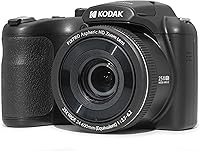
Kodak PIXPRO AZ405 vs AZ425: Which to Buy? (November 2026)
The Kodak PIXPRO AZ425 is the better buy for most people. It has a 42x zoom, a BSI CMOS sensor and a rechargeable battery, while the AZ405 trades a little reach for AA batteries that are easy to replace on a trip.
On this page (9 sections)
The Kodak PIXPRO AZ425 is the better buy for most people. It has the longer 42x zoom, a backside-illuminated sensor that gathers light more efficiently and a rechargeable battery rated for about 240 shots.
The AZ405 is no weak rival, though. It keeps a 40x zoom and adds a feature some travelers refuse to give up: it runs on standard AA batteries.
This kodak pixpro az405 vs az425 comparison looks at where the two cameras differ and which one suits your kind of shooting.


AZ405 vs AZ425 side by side
The AZ425 leads on reach, sensor design and battery life; the AZ405 leads on power flexibility. Here is how the two bridge cameras line up.
| Feature | KODAK PIXPRO AZ425 | Kodak PIXPRO AZ405 |
|---|---|---|
| Optical zoom | 42x | 40x |
| Wide angle | 24mm | 24mm |
| Sensor | 20MP BSI CMOS | 20MP CMOS |
| Stabilization | Optical | Optical |
| Video | 1080p Full HD | 1080p Full HD |
| Power | Rechargeable Li-ion, about 240 shots | 4 AA batteries |
| Memory | Class 10 SD, SDHC, SDXC up to 512GB | Class 10 SD, SDHC, SDXC up to 512GB |
| Our score | 9.4 | 7.2 |
The two cameras are close in shape and purpose. Both are compact bridge cameras with a built-in flash and a fixed rear screen.
The gaps that matter are the zoom range, the sensor type and what powers the camera. Each one changes how you shoot on a given day.
Zoom gets the most attention, but the sensor and the battery carry just as much weight over a whole trip. The zoom decides how close you can get, the sensor decides how the frame looks when the light is thin, and the battery decides whether the camera is still ready on day five.
The rest of the spec sheet is more even than the headline numbers suggest. Both shoot at f/3.0 and both offer a 4x digital zoom on top of the optical reach, so neither gives you a runaway advantage in software tricks.
Both also use a 9-point sensor autofocus, which is enough for a bridge camera aimed at travel and family use. You frame, half-press and the camera finds the subject, without the tracking modes a dedicated sports body would bring.
How much does the extra zoom matter?
The 2x gap sounds small, but it helps at the long end when a subject is far away. Both lenses start at 24mm, so group shots and wide landscapes look the same on either camera.
The difference shows up when you zoom all the way in. A 42x reach from 24mm pulls in a tighter crop than a 40x reach from the same starting point.
For birds in flight, athletes across a stadium or a performer on a distant stage, that extra bit of reach can fill more of the frame. It also means less digital zoom, which is where image quality starts to fall apart.
The AZ425's lens is where much of its 9.4 score comes from. The AZ405's 40x is still a real optical zoom, and it beats any phone's digital crop for distant subjects.
If your shooting is mostly family gatherings, travel scenes and nearby wildlife, the 2x difference rarely decides a photo. If you spend your days at the far end of the zoom, it does.
What 24mm wide angle means on both cameras
Both cameras start at the same 24mm wide angle, and that matters more than the zoom difference for everyday shots.
A 24mm start lets you fit a group portrait or a whole street scene into the frame without stepping back. Indoors, where you cannot back up through a wall, that wide start is what saves the shot.
Because both share the same starting point, wide shots look essentially the same on either camera. The zoom comparison only becomes real when you push toward the far end.
Which sensor handles low light better?
The AZ425's backside-illuminated sensor gathers light more efficiently, which helps in dim settings. The AZ405 uses a standard 20MP CMOS sensor.
Backside illumination moves the sensor's wiring behind the light-collecting area. That leaves more room for light to reach the pixels, which pays off at golden hour, indoors and under overcast skies.
The AZ405's 20MP CMOS sensor still produces detailed images with vibrant color, and both cameras can print large. The difference is in difficult light rather than in bright daylight.
For evening events, indoor gatherings or concerts where the light is dim, the AZ425 has the edge. For beach days, birthdays and sunny hikes, either camera does the job.
This is one of the quiet reasons the AZ425 scores higher overall. A sensor that copes with mixed light makes a travel camera more useful across a whole trip.
Both sensors are 8-bit and both deliver 20MP, so file size and print size are in the same league. The BSI design changes how well each pixel collects light, not how many pixels there are.
That means you will not see a resolution gap in the files. You will see it in shadow detail and color when the light drops, which is exactly where a bridge camera earns its keep on an evening walk.
Battery: rechargeable pack or AA cells?
The AZ425 uses a rechargeable lithium-ion battery rated for about 240 shots; the AZ405 takes four AA batteries. This is the choice that divides travelers most.
A rechargeable pack means charging at night and carrying a spare if you shoot heavily. You get a steady, predictable run time and no need to hunt for cells mid-trip.
AA batteries flip that. The AZ405 accepts standard AA cells sold worldwide, so a safari, a cross-country drive or a remote trail never depends on an outlet.
AA cells do run down faster than a lithium-ion pack, and a heavy shooter will burn through several sets. Packing a few spares is cheap and easy, though.
Pick the AZ425 if you shoot near power and like a single battery you recharge. Pick the AZ405 if your trips take you away from chargers and you want to top up at any store.
What comes in each box
The box contents tell you how each camera expects to be powered. The AZ425 ships with a rechargeable lithium-ion battery plus an AC adapter and a USB cable, so it arrives ready to charge.
The AZ405 ships with four AA alkaline batteries and a USB cable, but no AC adapter. It is designed to run on cells from the start, and the included set gets you going out of the box.
Both boxes include the camera, a neck strap, a lens cover, a quick start guide and warranty and service cards. Storage is not included either way, so you buy a Class 10 card separately.
Video and everyday controls
Both cameras record 1080p Full HD video and keep the controls simple for beginners. The AZ425 adds panorama and custom modes that give you room to grow.
For travel clips and school events, 1080p is enough for sharing and for a family archive. Neither camera pushes into 4K, which suits the price tier these bridge cameras sit in.
The AZ405 leans on automatic scene detection. Point it at the scene and the camera makes the technical calls, which keeps things quick for new users.
The AZ425 keeps simple controls and scene modes too, then adds panorama for wide views and custom modes for shooters who want more say. If you plan to grow into the camera, that matters.
Both take Class 10 SD, SDHC or SDXC cards up to 512GB and transfer over USB. One large card and a USB cable cover most trips, so you rarely need to swap storage in the field.
Frame shape and file options
The two cameras handle frame shape a little differently. The AZ425 offers a 16:9 aspect ratio, while the AZ405 gives you 16:9, 3:2 and 4:3.
That matters if you print at standard photo sizes. A 4:3 or 3:2 frame fits most print formats with less cropping, while 16:9 suits widescreen viewing.
Both shoot at 8-bit color depth and both save to the same Class 10 card types. A 512GB card holds thousands of photos and hours of 1080p video on either camera.
Image stabilization at full zoom
Both cameras use optical image stabilization to fight hand shake at full reach. It is the difference between a usable keeper and a soft frame when you zoom right in.
At 40x or 42x, even a small hand movement swings the frame wide. Optical stabilization compensates for that movement inside the lens, so handheld shots at full zoom stay sharp without a tripod.
Wildlife and sports are where you notice it most. You are often standing, tracking a moving subject and holding the camera at arm's length, which is the worst case for shake.
Neither camera promises a gimbal-smooth result. Both reward a steady grip and a moment of stillness before you press the shutter.
On this point the two are level. The AZ425's longer zoom makes stabilization slightly more valuable there, but each camera leans on the same approach.
The AZ405 lists a tripod socket among its compatible mountings, which gives you a second way to steady a long shot. A cheap tripod plus OIS is the most reliable path to a sharp frame at full zoom.
Who should buy the AZ425?
Buy the AZ425 if you want the longest reach and the better low-light sensor in one travel camera. It is the pick for most readers who want a single bridge camera to cover everything.
Wildlife watchers, sports parents and anyone who shoots stage events benefit most. The 42x zoom and the BSI sensor work together when the subject is far off and the light is not ideal.
The rechargeable battery suits shooters who return to a hotel, a car charger or a home outlet each night. About 240 shots per charge covers a normal day of travel.
It also makes sense if you want a camera that grows with you. Panorama and custom modes give you more room than the AZ405's automatic approach.
If you are still deciding whether a compact camera earns a place in your bag, our guide on whether compact cameras are worth it lays out the trade-offs against a phone.
Who should buy the AZ405?
Buy the AZ405 if AA batteries matter more than 2x of zoom. It is the camera for long trips where an outlet is never guaranteed.
Think of a safari, a camping loop or a road trip through remote country. Four AA cells from any shop keep the camera running, and you never wait for a charger.
The 40x zoom still reaches birds, athletes and performers. Automatic scene detection keeps the camera quick to use when you would rather shoot than adjust settings.
Its 20MP CMOS sensor handles bright days well and prints large. You give up a little low-light headroom and a little reach, and you gain freedom from the wall socket.
Families who hand a camera to different people also like AA power. Anyone can swap cells without hunting for the right charger in a bag.
A closer look at the spec gaps
Some numbers favor the AZ425 in ways the headline comparison misses. It lists continuous shooting at 7 frames per second and a data transfer rate of 480 megabits per second over USB.
The AZ405 lists continuous shooting at 30 frames per second. That figure is worth checking against how you plan to shoot, since burst speed matters for action and less so for landscapes.
Both cameras carry a built-in flash and a fixed rear screen. Neither has a viewfinder or a tilting display, so you frame on the back screen on both.
The AZ425 ships with an AC adapter and the AZ405 does not. If you buy the AZ405 and shoot heavily on AA cells, a charger and a few rechargeable AAs make a sensible addition to the kit.
Which Kodak PIXPRO bridge camera wins?
The AZ425 wins the kodak pixpro az405 vs az425 matchup for most people. It scores 9.4 against 7.2 because it pairs the longest zoom here with a light-friendly sensor and a battery that lasts a full day.
Pick the AZ425 if you shoot distant subjects in mixed light and stay near power at night. Pick the AZ405 if AA batteries are the feature you cannot do without on the road.
Both are bridge cameras in the classic sense: a wide 24mm start, a long optical zoom and stabilization to hold it steady. The rest comes down to your trips and your charging habits.
If you want to see how these two fit the wider lineup, our roundup of the best Kodak PIXPRO cameras puts them beside the rest. For a pocketable alternative, read the Kodak PIXPRO FZ55 review or our Kodak PIXPRO FZ55 vs FZ45 comparison.
Frequently asked questions
Is the Kodak PIXPRO AZ425 better than the AZ405?
For most people, yes. The AZ425 has a longer 42x zoom, a backside-illuminated sensor that handles low light better and a rechargeable battery rated for about 240 shots.
The AZ405 is the better choice only if you value AA batteries more than that extra reach.
Do both cameras have optical image stabilization?
Yes. Both the AZ405 and the AZ425 use optical image stabilization, which helps you hold a sharp frame at full zoom without a tripod.
That matters most for wildlife, sports and stage shots where you are reaching across a long distance.
Which camera has the longer zoom, the AZ405 or the AZ425?
The AZ425 has a 42x optical zoom and the AZ405 has a 40x zoom. Both start at a 24mm wide angle, so the difference shows up at the far end when you are trying to pull in a distant subject.
Can I use AA batteries in the Kodak PIXPRO AZ425?
No. The AZ425 runs on a rechargeable lithium-ion battery, rated for about 240 shots per charge.
The AZ405 is the AA model, and it takes four standard AA cells you can buy almost anywhere.
What memory cards do these Kodak bridge cameras take?
Both take Class 10 SD, SDHC or SDXC cards up to 512GB. A Class 10 card keeps up with 1080p video and burst shooting, and a larger card lets you leave it in the camera for a whole trip.